

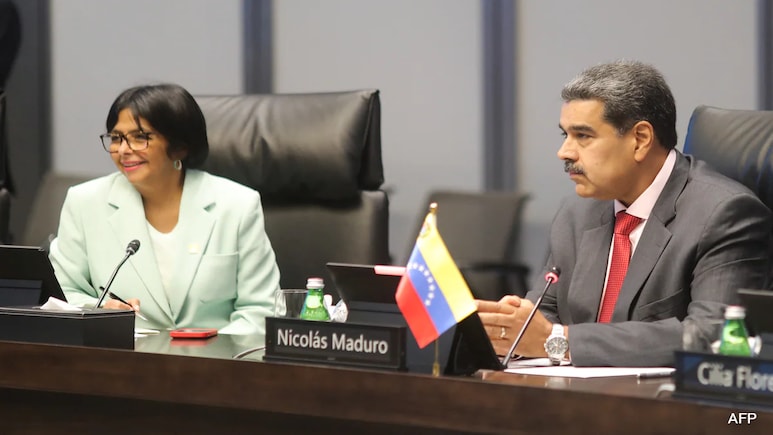
Delcy Rodríguez, Venezuela’s powerful vice president and a longtime ally of Nicolás Maduro, has emerged at the centre of global attention after former US President Donald Trump claimed she had replaced Maduro following his alleged capture by US forces.
Trump’s remarks, delivered early Saturday, suggested Rodríguez had been “sworn in” as president and was cooperating with Washington, even going so far as to say the United States would be “running Venezuela” in the near future. Those claims were swiftly contradicted by Rodríguez herself, who insisted that Maduro remains Venezuela’s only president.
Defying Trump’s claims
In a televised address broadcast on state media, Rodríguez appeared in Caracas, pushing back against reports that she was in Russia. She dismissed Trump’s statements and demanded proof that Maduro and his wife were alive, calling on the US government to provide evidence.
Her appearance underscored her role as Maduro’s most visible defender at a moment of political turmoil. Maduro has previously described Rodríguez as a “tiger” for her fierce and unwavering defence of his socialist government.
Political roots and family legacy
Born on May 18, 1969, in Caracas, Delcy Rodríguez is 56 and comes from a deeply political family. She is the daughter of Jorge Antonio Rodríguez, a left-wing guerrilla leader and founder of the Liga Socialista party in the 1970s. Her father died in custody in the 1970s, a legacy that has shaped her political identity and rhetoric.
She works closely with her brother, Jorge Rodríguez, who currently serves as the head of Venezuela’s National Assembly, making the siblings one of the most influential power duos in the country’s leadership.
From law to the heart of power
Rodríguez is a trained attorney who graduated from the Universidad Central de Venezuela. Over the past decade, she has risen rapidly through the political ranks.
She served as Minister of Communication and Information between 2013 and 2014 before being appointed foreign minister, a post she held from 2014 to 2017. During her tenure, she was known for her combative diplomatic style, including an incident in which she attempted to force her way into a Mercosur trade bloc meeting in Buenos Aires after Venezuela was suspended from the group.
In 2017, she became head of the pro-government Constituent Assembly, a body that significantly expanded Maduro’s powers and sidelined the opposition-led parliament.
Economic power broker
Rodríguez was named vice president in June 2018, with Maduro praising her as “brave, seasoned, and tested in a thousand battles.” Over time, her influence only grew.
Iran Protests Spread Beyond Tehran as Economic Crisis Fuels Unrest, At Least Six Dead
Holding the vice presidency alongside key economic portfolios, including finance and oil, Rodríguez has become a central figure in managing Venezuela’s battered economy. Despite her revolutionary background, she has implemented relatively orthodox economic measures in an effort to rein in runaway inflation and stabilise relations with the weakened private sector.
In August 2024, Maduro added the oil ministry to her responsibilities, tasking her with navigating escalating US sanctions targeting Venezuela’s most critical industry.
A polarising figure
Known for her sharp rhetoric and taste for designer fashion, Rodríguez remains a deeply polarising figure. Supporters see her as a disciplined revolutionary loyal to the Bolivarian project, while critics view her as a symbol of the entrenched elite that has presided over Venezuela’s economic collapse.
As uncertainty swirls around Maduro’s fate and Trump’s dramatic claims continue to reverberate, Delcy Rodríguez stands firmly at the centre of Venezuela’s political storm — projecting authority, rejecting foreign assertions, and positioning herself as the regime’s most resolute public face.