

ISRO Releases Advanced Chandrayaan-2 Data to Study Moon’s Polar Regions
The Indian Space Research Organisation (ISRO) on Saturday announced that it has collected advanced data from the Chandrayaan-2 lunar orbiter to deepen understanding of the Moon’s polar regions — including insights into their physical and dielectric properties.
Calling it a major contribution to future global lunar exploration, ISRO said the Chandrayaan-2 Orbiter, launched in 2019, continues to provide high-quality data from its lunar orbit.
One of its key instruments, the Dual Frequency Synthetic Aperture Radar (DFSAR), is the first to map the Moon using the L-band in full-polarimetric mode at a high spatial resolution of 25 metres per pixel. This radar sends and receives signals in both vertical and horizontal directions, making it ideal for analysing surface characteristics.
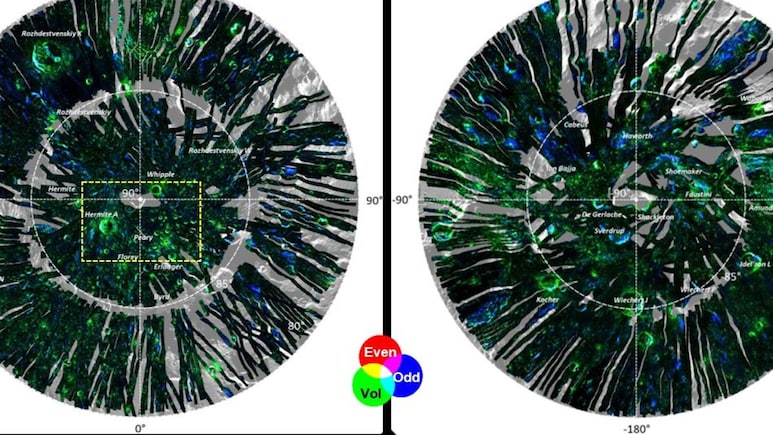
Since its launch, the orbiter has gathered about 1,400 radar datasets, which have been processed into polarimetric mosaics of the Moon’s north and south poles (between 80° and 90° latitudes).
Using these datasets, scientists at ISRO’s Space Applications Centre (SAC) in Ahmedabad have developed advanced data products indicating potential water-ice presence, surface roughness, and an important electrical property — the dielectric constant — which helps reveal the density and porosity of the lunar surface.
ISRO said the algorithms for analysing the full-polarimetric data and generating these products have been developed indigenously.
“These advanced data products offer crucial first-order information about the Moon’s polar regions, which are believed to have preserved the early chemical conditions of the solar system,” the space agency said.
Such comprehensive datasets, ISRO added, are highly sought after for future lunar missions as they provide a holistic understanding of the Moon’s surface and subsurface. The new radar products also complement hyperspectral data used for studying lunar mineral distribution.
The derived Polar Mosaic products (Level 3C) — which include key radar parameters describing the Moon’s physical and dielectric characteristics — are now freely available to researchers on the Indian Space Science Data Centre (ISSDC)’s PRADAN platform.